What is a DittoSheet?
A DittoSheet started as a worksheet copied on a spirit duplicator, the hand-cranked "ditto machine" found in most American school offices from the 1920s until photocopiers replaced it in the 1980s. The ink was purple, and fresh copies smelled faintly of alcohol when the teacher handed them out. If you were in school before about 1990, you probably took spelling tests on them. Today a DittoSheet is a worksheet made in DittoSheets from any text.

How a ditto machine worked
The teacher wrote or typed on a two-layer ditto master. The top sheet was ordinary paper. Behind it sat a sheet coated in waxy aniline dye, almost always purple, and every pen stroke or typewriter strike transferred a mirror image of that dye onto the back of the master.
The master was clipped to the drum of the spirit duplicator. As the drum turned, each blank page was moistened with a thin film of solvent, usually a methanol and isopropanol blend called duplicating fluid, and pressed against the master. The solvent dissolved a tiny amount of dye from the master onto the page. The "spirit" in spirit duplicator refers to that alcohol.
Every copy took a little dye with it, which is why a master was good for only forty to a hundred copies before the print went pale, and why the last row of the class got the faintest worksheet. Ditto Corporation of Chicago sold the most popular machines, and its brand name became the generic word, the way Xerox did for the machine that replaced it.
A short timeline
- 1923: Wilhelm Ritzerfeld patents the spirit duplicator in Germany. Ditto Corporation brings it to American offices and schools.
- 1930s to 1960s: the ditto is the school's copier. Worksheets, tests, permission slips and the class newsletter all come off the drum, purple.
- 1970s: plain-paper photocopiers arrive but cost too much for most schools. The ditto machine holds on because a master costs pennies.
- 1980s: photocopier prices fall, and the ditto machine goes to the storage closet. Most schools have retired theirs by about 1990.
- Today: "ditto" survives as a word for any handout, and for the idea it always stood for: the same thing, again.
Why we called it DittoSheets
"Ditto" means the same, again. That is also how anything gets memorized: the same text, again, in a form that asks a little more each time. The original DittoSheet put the same page in front of every student. We kept the name and built a new tool around that idea.
A DittoSheet is a worksheet you generate from any text in about a minute: copywork to write it out, first letter hints to recall it, and memory lines to write it from memory. It prints as a PDF, as many copies as the class needs, and the last copy is as clear as the first.
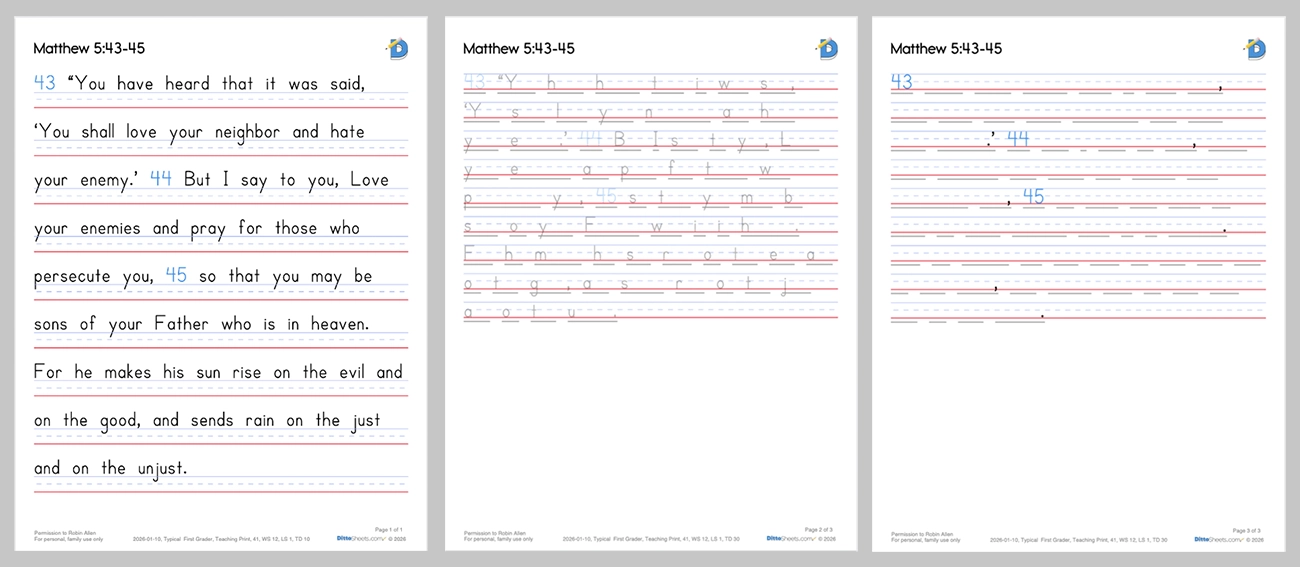
The modern DittoSheet, in three steps
The Preamble to the Constitution, printed three ways.

The whole text, copied by hand.

Each word is down to its first letter. The student supplies the rest from memory.

Only punctuation remains. A student who can fill it in has the text memorized.
There is much more to DittoSheets than the three steps. The tour shows every sheet type, font, line style and teacher tool, and which plan includes each one.
Tour every featureDittoSheet FAQ
Make a DittoSheet of your own
Make a DittoSheet from any text
Paste any text and print a copywork, first-letter and memory-line set in about a minute.
Free: 20 pages a month, no card. Plus trial: card required, nothing charged for 7 days.